Workshop Registration
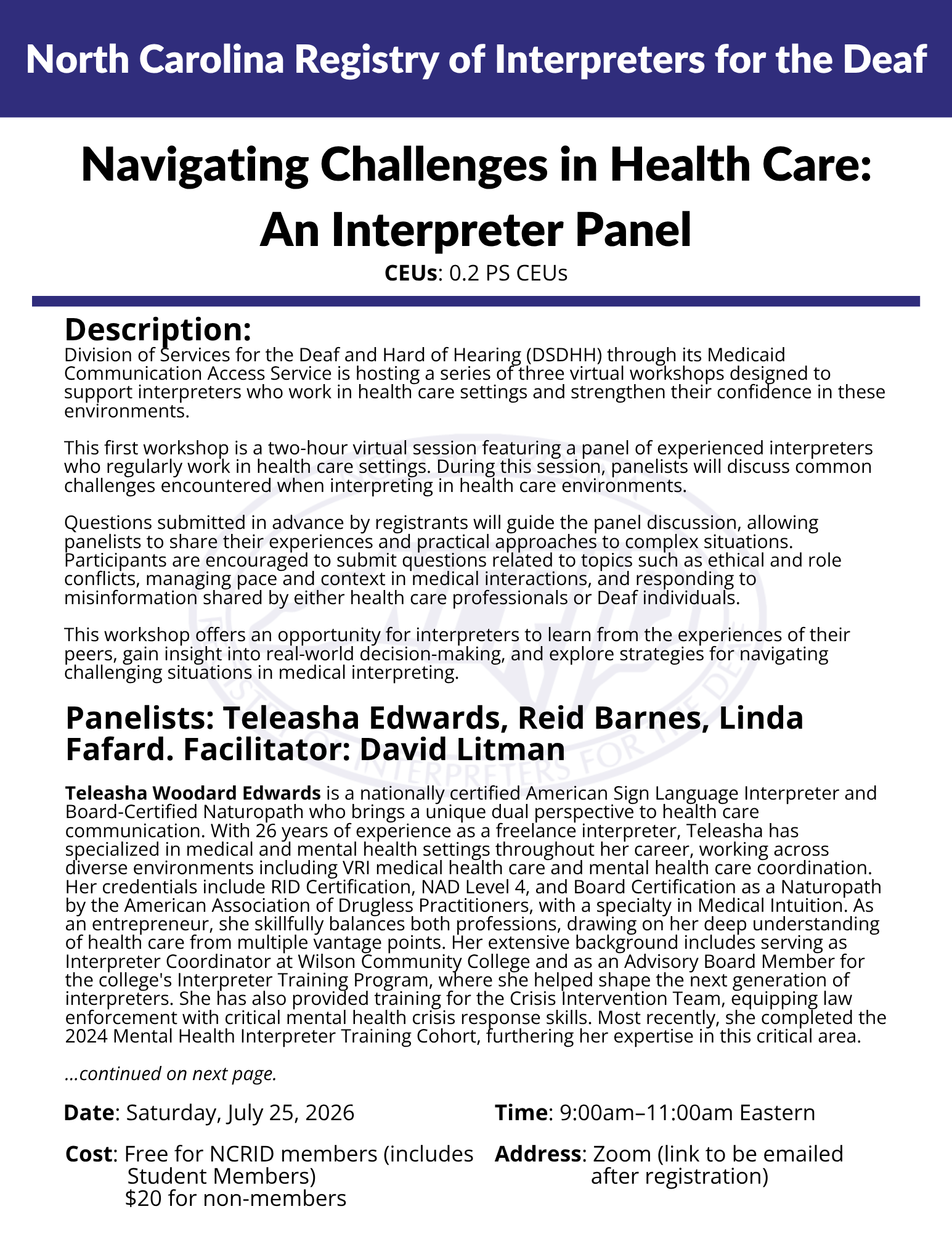
Navigating Challenges in Health Care: An Interpreter Panel

Navigating Challenges in Health Care: An Interpreter Panel
This is registration for one person for the workshop “Navigating Challenges in Health Care: An Interpreter Panel” on 7/25/26. All times are in EST.
PLEASE NOTE:All online transactions will have a small additional electronic processing fee.
Division of Services for the Deaf and Hard of Hearing (DSDHH) through its Medicaid Communication Access Service is hosting a series of three virtual workshops designed to support interpreters who work in health care settings and strengthen their confidence in these environments.
This first workshop is a two-hour virtual session featuring a panel of experienced interpreters who regularly work in health care settings. During this session, panelists will discuss common challenges encountered when interpreting in health care environments.
Questions submitted in advance by registrants will guide the panel discussion, allowing panelists to share their experiences and practical approaches to complex situations. Participants are encouraged to submit questions related to topics such as ethical and role conflicts, managing pace and context in medical interactions, and responding to misinformation shared by either health care professionals or Deaf individuals.
This workshop offers an opportunity for interpreters to learn from the experiences of their peers, gain insight into real-world decision-making, and explore strategies for navigating challenging situations in medical interpreting.
Educational Objectives
At the conclusion of this workshop, participants will be able to:
Identify common challenges experienced by interpreters working in health care environments, including ethical dilemmas, role conflicts, and communication barriers.
Describe strategies used by experienced interpreters to manage ethical and role conflicts that arise in medical interpreting situations.
Explain approaches for navigating pace, complex medical context, and communication flow during health care interactions.
Discuss techniques for addressing or managing misinformation shared by either the medical professional or the deaf individual while maintaining professional interpreting standards.
Reflect on personal interpreting practice and identify at least one strategy they can apply to increase confidence when interpreting in health care settings.
Formulate questions and engage in discussion with experienced interpreters to deepen understanding of real-world decision-making in health care interpreting settings.
Moderator: David Litman; Panelists: Teleasha Edwards, Reid Barnes, Linda Fafard
Teleasha Woodard Edwards is a nationally certified American Sign Language Interpreter and Board-Certified Naturopath who brings a unique dual perspective to health care communication. With 26 years of experience as a freelance interpreter, Teleasha has specialized in medical and mental health settings throughout her career, working across diverse environments including VRI medical health care and mental health care coordination. Her credentials include RID Certification, NAD Level 4, and Board Certification as a Naturopath by the American Association of Drugless Practitioners, with a specialty in Medical Intuition. As an entrepreneur, she skillfully balances both professions, drawing on her deep understanding of health care from multiple vantage points. Her extensive background includes serving as Interpreter Coordinator at Wilson Community College and as an Advisory Board Member for the college's Interpreter Training Program, where she helped shape the next generation of interpreters. She has also provided training for the Crisis Intervention Team, equipping law enforcement with critical mental health crisis response skills. Most recently, she completed the 2024 Mental Health Interpreter Training Cohort, furthering her expertise in this critical area. Beyond her clinical and interpreting work, Teleasha is a dedicated leader in the deaf and interpreting communities. She is a founding member of the National Alliance of Black Interpreters - North Carolina (NAOBI-NC), where she has served in pivotal leadership roles including Vice President and President. Through these positions, she has championed advocacy, mentorship, and professional development for Black interpreters while advancing equity and excellence in the field. When she's not providing interpreting services or naturopathic care, Teleasha embraces life as a homeschooling mother, traveling internationally with her family and tending to her farm where she grows vegetables. Her commitment to bridging health care knowledge with linguistic access, combined with her leadership experience and holistic approach to wellness, makes her a valuable voice in discussions about navigating the complex challenges interpreters face in health care settings.
Reid Barnes is a nationally certified interpreter currently working at ECU Health as their staff ASL interpreter and service coordinator. As a health care interpreter, providing quality access for the Deaf and Hard of Hearing community is his number one priority. Implemented in 2024, Reid established a medical ASL interpreting residency program at ECU Health to provide supervised training for interpreters wishing to get into the medical field. Reid began his interpreting career in 2016 upon graduating from Wilson Community College. He has worked in a variety of disciplines including education, freelance, religion, and, of course, medicine. Reid has co-chaired the NCRID eastern representative seat alongside Melissa Gresia and maintains active membership with NCRID. He is currently serving on the advisory board for Wilson Community College’s interpreter training program and hosts interns to give back and grow future interpreters. Fun fact: While living abroad in Hungary, Reid almost gave away his train ticket to a homeless man walking the aisle, begging for money. That was when Reid decided to learn some Hungarian.
Linda Fafard, NIC, received her RID-NIC certification in 2008 and began her career as a freelance and agency interpreter in Connecticut. Early in her career Linda had the great privilege of being mentored by several CDI’s and hearing interpreters. Her interpreting experiences are diverse including educational, community, mental health, post-secondary, Vocational Rehabilitation, VRI/VRS and corporate arenas. Linda has also worked as a staff interpreter and for a state in-patient psychiatric Deaf specialty unit in Massachusetts. In 2017 Linda relocated to North Carolina where she continued working as VRS and freelance interpreter. Linda continues to be active in the interpreting community as a mentor. Linda is delighted to be the Foothills Regional Representative for NCRID.
David Litman is the Medicaid Communication Access Coordinator with the Division of Services for the Deaf and Hard of Hearing (DSDHH). He received a BA degree in Child Psychology and Deaf Studies from the University of Minnesota and a MSW from Gallaudet University. Mr. Litman has over fifteen years of experience in working with Deaf, DeafBlind and Hard of Hearing individuals advocating with them to receive equitable access in a variety of settings. In his current role, he is focusing on health care settings to ensure patients and their companions who receive Medicaid receive effective communication. Mr. Litman became deaf at the age of 26 and this personal experience as a late deafened adult helps drive his passion to educate professionals about hearing loss.